
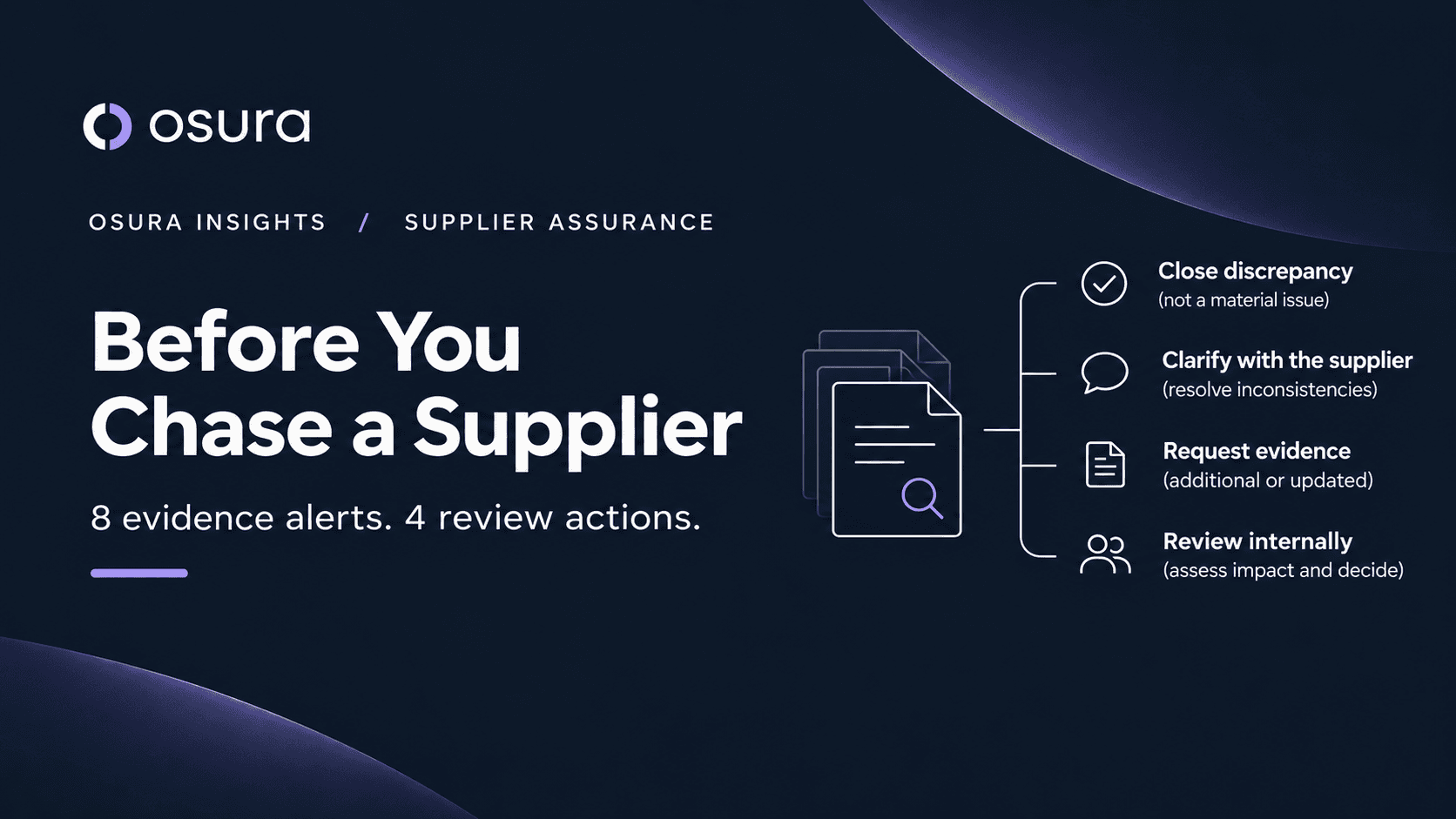
A practical guide to supplier risk assessment follow-up questions, with a fictional evidence casebook and example requests.
A supplier can answer every security question and still leave an assessment unresolved.
Sometimes the missing piece is another document. Sometimes it is a technical explanation. Sometimes the buyer already has enough information to close the discrepancy—but not enough to close the assurance requirement.
Those are three different situations, and sending the same generic follow-up in each one creates work without necessarily improving the assessment.
Consider a supplier that states its customer-facing API has a four-hour recovery time objective (RTO). Its corporate continuity plan lists 24 hours. Asking it to explain the two numbers seems reasonable—until the reviewer notices the second number refers to employee email, not the API. The apparent conflict disappears. Evidence that the API can actually meet its four-hour objective might still be needed.
The question is not simply “What doesn't match?” It is “What exactly is unresolved, and who needs to do something about it?”
To make this practical, we examine eight supplier evidence alerts and the different actions each may require.
Why supplier follow-ups become inefficient
A supplier assessment involves claims, evidence, requirements and decisions. A questionnaire answer is a claim. A report or test record may provide evidence, but only within its actual scope and period. A buyer's security or resilience requirement establishes the standard against which the evidence is assessed. A human reviewer must determine what is established, what remains uncertain and what should be escalated.
The UK National Cyber Security Centre (NCSC) recommends choosing proportionate assurance requirements according to a supplier's criticality and the risk of the relationship. It also advises assessors to decide what supporting evidence they need after receiving supplier answers. It warns that security questionnaires can create unnecessary work if treated as box-ticking exercises. NCSC, Supplier assurance.
NIST SP 800-53A likewise describes control assessment as a structured use of examination, interviews and tests against assessment objectives. It is not a rule that every discrepancy requires another document. NIST SP 800-53A Rev. 5.
The practical risk is two-sided: indiscriminate follow-ups can burden suppliers and reviewers, while premature closure can leave required assurance unresolved.
The two-queue review: an evidence issue and a communication action
For each alert, record two separate states rather than a single pass/fail flag.
Queue 1 — Assurance state: What does the available evidence establish about the specific customer requirement? Is the requirement evidenced, not evidenced, or supported by evidence of an exception? What is still unknown?
Queue 2 — Next action: What should happen now? Close an irrelevant comparison, clarify internally, send a precise supplier request, validate technically, escalate an exception, or refer the remaining uncertainty to the authorised risk owner.
A closed comparison does not mean that the control is assured. Likewise, an open assurance gap does not mean a control has failed.
Before writing to a supplier, check four things:
- Scope: Are the statements about the same service, entity, system, time period and measurement?
- Requirement: Which agreed customer requirement or risk exposure makes this issue relevant?
- Decisive information: What specific fact or evidence could resolve the uncertainty or change the assessment?
- Recipient: Is the supplier actually the right person to answer, or should the reviewer first check an existing source, consult an internal specialist or escalate a decision?
These four checks are a practical review aid, to be used alongside applicable policies, contracts and evidence requirements.
Eight evidence alerts: what to ask and what to close
Consider CedarPay, a payments firm assessing Meridian Services, a provider of a reconciliation API. CedarPay requires the API to recover within six hours, current assurance covering that service, and MFA for interactive privileged production access.
Illustrative example: CedarPay, Meridian Services and all eight cases are fictional. They are not customer findings or performance results.
| Alert | What the submitted evidence shows | First justified action | What could resolve or change the issue |
|---|---|---|---|
| 1. Different recovery targets | API RTO: four hours. Corporate email RTO: 24 hours. | No discrepancy-specific email. Record the scope distinction; assess API recovery evidence separately if required. | Evidence that 24 hours really applies to the API would reopen the comparison. |
| 2. Incident notice timings | Internal goal: communicate within 24 hours of confirming customer impact. Contract: notify within 72 hours after awareness of an incident affecting the service. | Check the contract and buyer requirements first. Different triggers and a shorter internal target can coexist. | A conflicting same-trigger obligation, or a 72-hour contractual limit that fails CedarPay's requirements, would need action. |
| 3. Recovery test shortfall | API objective: four hours. Exercise for the same API: seven hours. | Targeted supplier request and specialist review. Ask for test scope, root cause, remediation and later testing. | Corrected scope or newer in-scope testing may change the present assurance position; it does not erase the earlier result. |
| 4. Privileged MFA alert | All privileged interactive accounts are claimed to use MFA; an export lists one privileged account with mfa_enabled=false. | Technical validation first. Verify account status and enforcement across identity layers, then request missing facts if needed. |
Three examples of better follow-up questions
Case 3 — Ask about the failed test, not the policy
Weak: “Your recovery information is inconsistent. Please clarify and resend your BCP.”
More useful: “We're reviewing the production reconciliation API against our six-hour recovery requirement. Your questionnaire states a four-hour RTO, while the 20 October recovery exercise recorded seven hours against that objective. Could you confirm the test scope, cause of the overrun, corrective actions, and whether a newer in-scope test is available? If a new test is planned, please provide its date.”
This keeps the historical exercise result visible while identifying the information needed to assess current capability.
Case 6 — Ask for the missing quarter
Weak: “Please provide all your business continuity testing documentation again.”
More useful: “Your questionnaire says restoration testing is quarterly, but the index supplied covers Q1 and Q2 only. Please share the Q3 record for the relevant production service, or confirm whether Q3 testing occurred and why the record is unavailable.”
The absence of an attachment is not proof the test was not performed. It is still an assurance gap if the buyer requires that record.
Case 7 — Ask for scope, not another badge
Weak: “Please send evidence that you're SOC 2 compliant.”
More useful: “The report provided excludes the production reconciliation API that CedarPay will use. Please provide the applicable in-scope assurance for that service and period, or describe the alternative evidence available for the required controls.”
A report that does not cover the service is not evidence that the controls have failed. It simply cannot close the relevant assurance question on its own.
A decision-ready follow-up record
A reviewer should be able to fill in the following before sending a request:
| Field | Record |
|---|---|
| Supplier and service | Name the exact contracted service, system and legal entity |
| Buyer requirement | State the applicable policy, contract or risk criterion |
| Observed claim | Quote the supplier's statement and source |
| Evidence and limitation | Cite the document, date, scope and what it does or does not prove |
| Current assurance state | Supported / not established / evidence-supported exception / technical validation pending |
| Exact information needed | Name the fact, record or explanation that could resolve the issue |
| Action owner and deadline | Supplier, assessor, specialist or authorised risk owner |
| Closure rule | What evidence satisfies this step; what remains open afterwards |
The closure rule matters. A reviewer can close a misleading comparison while keeping a separate recovery assurance requirement open. Without this distinction, an apparently tidy workflow can hide unresolved risk.
How to test whether this improves assessment work
This casebook demonstrates the logic of targeted review; it does not demonstrate improved accuracy or lower costs. To evaluate those claims, a TPRM team would need real or appropriately representative cases assessed against agreed requirements, independent specialist judgements, and a baseline process for comparison.
A useful evaluation would measure five things together: unsupported escalations, missed material findings, supplier requests that actually resolve a stated uncertainty, reviewer agreement, and reviewer time. Fewer follow-ups alone would not be success if material issues were being missed.
That is particularly important for AI-assisted assessment. A system may correctly detect text differences while failing to understand document scope. It may equally suppress a relevant exception. Source-linked outputs, uncertainty, specialist review and customer-owned final risk decisions therefore remain essential.
The principle
A supplier follow-up is worthwhile when it helps resolve an assurance requirement, clarify a material uncertainty or progress a necessary decision.
Before sending another request, identify the exact question the answer must resolve. If the question is about the wrong system, an already-explained difference or a judgement that belongs with the buyer's risk owner, another generic email may not help.
The aim is not fewer questions at any cost. It is fewer unnecessary questions and clearer action on the risks that matter.
About Osura
Osura is developing an AI-native third-party risk management platform and managed service focused on the work behind supplier assessments. AI assists with evidence review and follow-up preparation; Osura specialists review and quality-check findings; the customer retains final risk decisions. Learn more at osura.io.